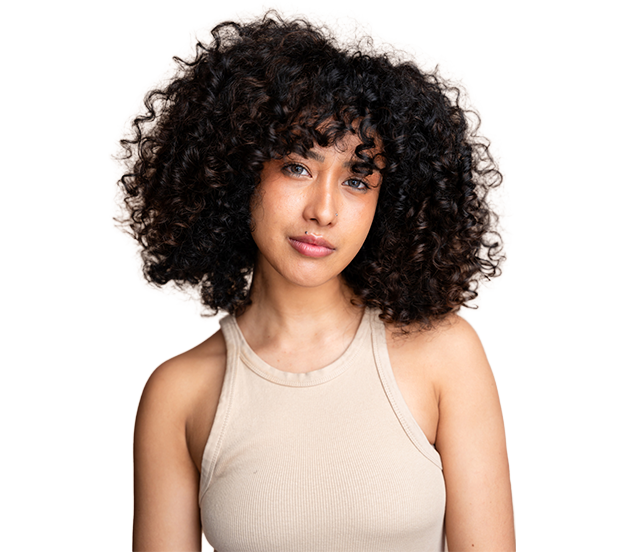



Volume at the roots is a real ongoing issue for many curly-haired women. The curls are actually nice, defined and well-groomed - and yet the roots often lie flat on the head. This quickly makes the hairstyle look heavy or weak, even though the lengths look exactly how you want them to.
The reasons for this vary greatly. Sometimes it's products that are too rich, sometimes a styling routine that unconsciously weighs down the roots. The haircut or small everyday habits also play a role. In this article, we take a look together at how you can give your roots more lightness, body and fullness again - with simple, everyday tips that support your curls and don't work against them.
Care & cleaning - why the roots often go flat
The problem with flat curls often starts where you least expect it: with care. Many curly heads mean particularly well with their hair - rich conditioners, nourishing masks, oils and leave-ins are an integral part of the routine. This is usually perfect for the lengths, but often too much of a good thing for the roots.
The hairline needs one thing first and foremost: lightness. If product residue builds up there or if too much care is applied directly to the scalp, the hair loses its elasticity and lies flat more quickly. That's why it's worth applying conditioner, masks and rich leave-ins only to the lengths and ends - not all the way to the top.
Cleaning also plays an important role. If you wash very mildly or use co-wash frequently, you risk build-up at the roots over time. The hair then feels soft, but has hardly any hold. A gentle shampoo that cleanses the scalp thoroughly but gently can work wonders here. Every now and then, you can also use a deep cleanse to remove old residue and give the roots some air again.
Another point is the balance between moisture and protein. If the hair lacks structure, the curls often hang down limply. Light protein care can help to give the roots more stability again without drying them out. The important thing is to observe, try out and listen to your own curl structure - because volume at the roots is not created by "more", but by the right application.
Styling - how technology gives the approach more stability
In addition to care, styling is the main factor that determines whether curls get volume at the roots or not. It's often small steps that make a big difference. Many curly heads style their hair very close to the head, brush products in from top to bottom or leave the curls to dry in the exact position in which they are to lie later. This feels controlled, but takes away any chance of the roots standing up.
It is helpful to consciously work against gravity when styling. This starts with applying the products: When kneading in gel, cream or mousse, hold individual sections slightly away from your head or tilt your head to the side. This prevents the roots from drying directly on the scalp and gives them some air right from the start.
The diffuser is a tried and tested aid. When blow-drying overhead or in alternating head positions, the roots are lifted and dry with more stability. It is important to work with low heat and little air so that the curls are not blown apart. Patience pays off here - it is better to blow-dry a little longer and more gently than fast and hot.
Many curly hairstylists also swear by root clipping. This involves fixing individual strands at the roots with small clips or clamps while the hair dries. This may sound unusual at first, but it works surprisingly well - especially on the top of the head or along the parting. After drying, the clips are removed and the roots remain visibly looser.
The parting itself also has a strong influence on volume. If it is always in the same place, the hair adapts over time and automatically falls flat. An occasional change - sometimes a little further to the left, sometimes further to the right or slightly zigzagged - can immediately add volume without any additional product.
Another simple but very effective trick is to keep flipping the curls from left to right - and also forwards or backwards - while drying. If the hair dries in the same position the whole time, it lies directly against the scalp and loses its hold. By consciously repositioning the hair, the roots are given movement and do not dry flat, but straighten themselves again and again. This naturally creates more volume without the need for additional product or heat.
Products for more volume at the roots - what really helps?
There is often a lot of uncertainty when it comes to products. Many curly-haired people wonder why their curls are soft and well-groomed, but there is still no volume at the roots. The answer often lies in the choice of product. Not every curl product that works wonderfully on the lengths is also suitable for the roots.
Anything that is very rich - heavy creams, butters or oil-based leave-ins - can weigh down the roots and make them look flat more quickly. This does not mean that these products are bad, but that they should be used selectively. At the roots: less is more. Light formulations give the hair hold without pulling it down.
Curl mousses or airy mousse products have proven particularly effective. They provide structure and hold without weighing the hair down and are therefore ideal for the roots. One or two pumps, gently worked into the roots, are often enough to create visibly more volume. You can then continue to work the lengths as usual with gel or cream.
Volumizing sprays or special root products can also help, especially on day two or three after washing. They provide grip and absorb excess sebum, which immediately makes the roots look looser. It is important that these products are curl-friendly and do not dry out - alcohol at the top of the ingredients list is usually a sign that they are less suitable for curls.
If your roots keep falling apart despite styling, it is worth taking a critical look at your own routine. Often just switching to a lighter product or making a small adjustment to the sequence will have the desired effect.
Haircut & everyday life - how to keep volume at the roots in the long term
As important as care, styling and products are - without the right haircut, it is difficult for many curly heads to maintain volume at the roots. Very long, unruly hair brings a lot of weight with it. This weight pulls the curls down, especially at the top of the head, and makes the roots look flat more quickly.
A curl-friendly layered cut can make a big difference here. Targeted layers take weight out of the lengths, allowing the curls at the roots to move more freely. The hair falls more airily, becomes more dynamic and looks fuller overall. It is important that the cut is tailored to the curls - ideally when dry so that you can see how the curls really fall. An experienced hairdresser will be able to judge where it makes sense to add layers without losing the shape.
You can find a selection of our customer-recommended hairdressers in Switzerland here
.
In addition to the cut, everyday habits also play a major role. Many curly heads unconsciously flatten their roots - for example, by wearing tight plaits, buns or hair bands that always sit in the same place. Variety helps: wear your hair down more often or change the position of the plait and parting so that the roots don't get used to a single direction.
The night also plays a role. If curls are flattened during sleep, they often lack any bounce in the morning. A loose pineapple bun at the top of the head or a satin pillowcase can help to reduce friction and protect the roots. As you can see, small everyday adjustments can make a big difference in the long term - and ensure that the volume at the roots doesn't just remain a random result, but remains stable.
In addition, sleeping with a sleep cap - often called a bonnet - can be very helpful. Under the satin bonnet, the curls are gently bundled, retain their shape and do not lie flat. The material is important here: synthetic satin is often the better choice, as natural fibers such as cotton or silk can draw moisture from the hair, which leads to frizz in the morning. In addition, high-quality satin is much easier to clean than pure silk and is hardly inferior in feel - so it feels just as pleasant, but is more suitable for everyday use.
Conclusion - small adjustments, big impact
Flat curls at the roots are not a sign of "wrong" hair, but usually the result of small details in care, styling or everyday life. A lot can be achieved with a light care routine tailored to the roots, conscious styling techniques and the right choice of product. Even the haircut and seemingly trivial habits such as sleeping position or parting play a bigger role than you might think.
In principle, it is enough to observe your own curls carefully and give them what they really need. Volume at the roots is not created by adding more and more products, but by striking the right balance between lightness, hold and movement. If you are prepared to experiment a little, you will soon realize how much potential there is in your own curls.