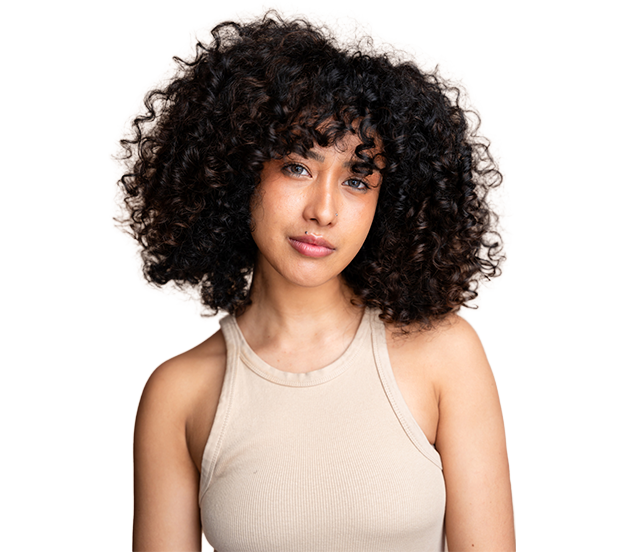



Curls are not complicated - they just react more sensitively to care, habits and products. Many problems such as frizz, lack of volume or an irritated scalp don't arise because curls are difficult, but because they are often treated like straight hair. Here are the five most common mistakes - and how to avoid them.
1. foam is not the same as cleaning
Many people automatically associate cleanliness with lots of foam. This is because we have been taught to do so for decades: The stronger a shampoo foams, the more "thorough" the cleansing feels. However, from a chemical point of view, foam and cleansing are two different processes.
Surfactants are responsible for the actual cleaning. Surfactants are washing-active substances that dissolve grease and dirt by binding to water and oil at the same time. They enclose dirt particles and allow them to be rinsed out with water. Foam, on the other hand, is created by the ability of certain surfactants to trap air.
Highly foaming sulphates such as sodium lauryl sulphate produce a lot of foam, but often cleanse very aggressively and can attack the natural lipid layer of the scalp. Milder surfactants such as coco glucoside or sodium cocoyl isethionate foam significantly less, but still cleanse effectively. The visible foam therefore says nothing about the actual cleansing power. Mild cleansing makes more sense for curls in particular, as it preserves the natural protective layer of the curl crown and does not irritate the scalp unnecessarily.
2. switching to the Curly Girl method takes time
When you switch from heavily degreasing shampoos to mild curl shampoos, your scalp often reacts irritated at first. For years, it has been completely degreased with every wash. To compensate for this, it has increased its sebum production.
If you now switch to milder products, the scalp is no longer radically cleansed - but initially continues to produce the same amount of sebum. This can feel greasy or unfamiliar. Some even report itching or slight dandruff during the transition phase.
This is not a malfunction, but a regulatory process. The scalp needs time to regain its balance. With patience, sebum production usually normalizes itself. A gentle scalp scrub can help to remove dead skin cells and stimulate blood circulation. The important thing is: Don't panic and resort to aggressive shampoos, but give your scalp time to adjust.
You can support your scalp with a gentle exfoliation:
DIY scalp scrub:
2 tbsp white sugar
2 tbsp olive oil
Stir well, divide curls into sections and massage gently into the scalp. Leave on for 5 minutes, then rinse out with shampoo.
White sugar is particularly suitable as it has optimal exfoliating properties and is easy to wash out.
3. co-wash is not suitable for every curl structure
Co-washing means cleaning the curls with conditioner only. This works because conditioners contain mild cationic surfactants that can dissolve light dirt. This can work wonderfully for very dry, frizzy curls.
However, fine or wavy curls often react sensitively to this method. Conditioners contain nourishing lipids and film-forming substances that make the hair supple. However, these substances can quickly add too much weight to fine hair. The curls lose their bounce and appear flat or stringy.
Fine hair in particular often lacks the structure to sustain rich care. A mild curly shampoo provides a better balance between cleansing and volume. Co-wash is therefore not a must for the Curly Girl method, but a tool that should be used individually.
4. too much styling product
Many believe that more product automatically brings more definition. In fact, too much styling can weigh down the curls and restrict their natural movement. Leave-ins, creams and gels contain film formers, moisturizers and oils. These substances wrap around the curl fibers and provide hold or smoothness.
However, if too much is used, excess weight is created. The curls are pulled down and lose volume. Fine curls are particularly sensitive to product build-up.
Less product often means more elasticity and more natural movement. A small amount, well distributed with water, is usually enough. With gel, it is often sufficient to gently scrunch the curls instead of soaking them completely. The aim is not to apply the maximum amount of product, but to distribute it evenly with sufficient hold.
5. comb curls dry
Dry combing curls is one of the most common mistakes. Curly hair has a spiral structure, which makes it easier for individual strands to get caught in each other. When dry, the cuticle layer is slightly open and there is more friction between the hair fibers.
This creates tension and mechanical stress when brushing. This leads to hair breakage, frizz and a destroyed curl structure.
However, if the hair is combed when damp, it is more elastic and supple. Conditioner or leave-in also provide slip. This makes it easier to detangle the strands without destroying the natural curl shape. Curls should therefore ideally be detangled in the shower or directly after washing. When dry, a gentle brush-up helps much more than brushing.
How can I tell which of these errors applies to me?
Many curl problems feel similar - but the cause is often completely different. That's why it's important not just to look at the symptoms, but to observe the behavior of your curls closely. Here you will find typical signs that can help you recognize your personal care mistake.
If your curls never feel really clean
Do your curls feel soft but "not quite fresh" after washing? Then you may still be expecting the usual squeaky feeling of heavily degreasing shampoos. Mild curl shampoos cleanse gently and preserve the natural protective layer of the curl crown. This makes the hair feel different - but not unkempt. Make sure you really only massage the shampoo into the scalp and lather up with a little water. Often the feeling is not due to a lack of cleansing, but to a change in expectations.
If your scalp becomes oily or itchy more quickly after switching
If your roots quickly become greasy or your scalp starts to itch after the changeover, your scalp is probably still in the regulation phase. It was used to being completely degreased with every wash and continues to produce more sebum at first. This is a normal adjustment reaction. With a little patience, sebum production usually regulates itself. A gentle scalp scrub can help to remove dead skin cells and promote balance.
If your curls look flat and limp
If your curls lack volume and bounce, even though they look soft and well-groomed, you may be using products that are too rich. Fine curls in particular react sensitively to heavy creams, butters or too much conditioner. The curls become weighed down and lose their natural hold. Lighter care and a styling product with good hold can help here without adding extra weight
If your curls are beautifully defined at the beginning and later fall apart
If your curls look perfect in the morning but lose their shape after a few hours, this may be due to an incorrect product balance. Either too much care has been used or there is a lack of hold. Too much product pulls the curls down, too little texture makes them fall apart more quickly. It is often enough to reduce the amount of product and instead work in a stronger holding styling product.
If your curls quickly appear frizzy and brittle
Severe frizz, small protruding hairs and hair breakage are often caused by mechanical stress. If curls are brushed dry, the strands become entangled. The cuticle layer is roughened and the natural curl structure loses its definition. Curls should therefore only be detangled when damp with sufficient care. When dry, a gentle brush-up helps much more than brushing.