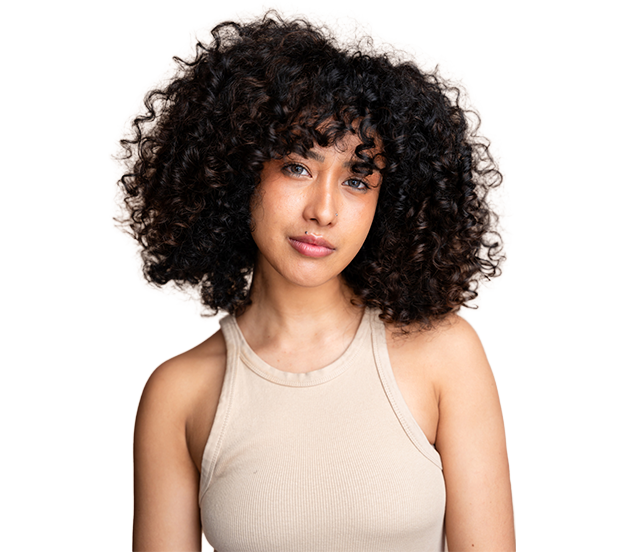



There are those mornings when your curls feel strange. Yesterday soft and defined - today flat, dry or knotted. And although you haven't done anything "wrong", nothing fits together anymore.
This is where the topic of sleeping curls begins. Not as an extra step in your routine, but as a crucial moment that shows how well your curls are protected.
Because more happens while you sleep than you think: friction, moisture loss and movement change your hair structure - night after night. When you learn to protect your curls overnight, it's not just your mornings that change. Your entire routine becomes calmer, easier and more reliable.
Why do curls lose their shape overnight?
If you have frizz in the morning, the problem almost always starts at night. Avoiding curly frizz has less to do with styling - and more to do with what happens as you move around in your sleep.
Curly hair is more sensitive because the natural protective layer is not evenly distributed. Every twist on the pillow causes friction. Especially with classic fabrics, this is exactly what you see in the morning: roughened strands, lost bundles, small knots.
You will often notice that individual curls "pull apart" instead of staying together as defined strands.
Another point is often underestimated: the moisture content of your hair. If you go to sleep with very wet hair, it is particularly stretchy - and therefore more susceptible to damage. The structure becomes unstable before it can even dry.
That's why it's not just about tying your hair up. It's about putting up as little resistance as possible at night.
Satin vs cotton: which surface your curls really need
The question of satin vs cotton is not a question of style - but one of the most important basics if you want to protect your curls overnight.
Cotton feels soft, but has a rather "grippy" effect on your curls. The surface creates friction. Your curls get caught, are pulled apart and lose their natural bundling. This is exactly where frizz begins.
In addition, many natural fibers such as cotton have an absorbent structure. They can absorb moisture from the curl fiber - precisely the moisture that keeps your curls supple and elastic. If this is lost, your curly mane will appear drier, rougher and more prone to frizz.
Satin, on the other hand, has a much smoother texture. The hair glides over it instead of rubbing against it. This keeps the shape of your curls for longer.
Many notice the difference after just a few nights: fewer knots, softer tips, smoother structure.
If you are currently still sleeping on cotton, switching to satin is often the easiest step with the greatest effect.
Silk goes one step further, but is not absolutely necessary. The decisive factor is not the most expensive material - but a surface that doesn't "slow down" your curls.
Which sleeping technique suits your curls
The best-known method is the Pineapple Method Curls - but it only works really well if it suits your hair.
The principle: Your curls are gathered loosely at the top of your head so that they are not pressed between your head and the pillow. The most important difference lies in the detail.
If you tie your hair too tightly, you lose exactly what you want: the natural shape. Pressure points are created and the curls look unruly or kinked in the morning. A loose fit is crucial. Your hair should be held in place - not fixed.
You will quickly notice if it fits: If you undo the plait and your curls almost "spring back", you've done it right.
For shorter or finer curls, a single pineapple often does not work optimally. Several small sections or loose twists help here. These distribute the pressure better and prevent individual sections from becoming flat.
And sometimes it turns out something completely different: that your curls don't need much at all.
Very fine or sensitive structures often benefit from being moved as little as possible. In such cases, gentle protection is completely sufficient.
Bonnet or pillowcase - which protects curls better at night?
When you start to want to protect your curls at night, the question quickly arises: Is a pillowcase enough - or do you need a bonnet?
A smooth pillowcase reduces friction. This is a big advantage. But your hair still moves freely. If you toss and turn a lot in your sleep, this can be enough to disrupt the curl structure.
A bonnet changes exactly that. It holds your hair together and limits movement. Your curls stay closer to their original shape. This makes a noticeable difference, especially with longer or thicker curls.
You can recognize it by the fact that your hair "falls apart" less in the morning and feels more closed. The fit is important here. A bonnet that is too tight creates pressure. One that is too loose will not stay in place.
If you have to choose, a bonnet is often the more effective solution. If you combine the two, you can increase the effect.
Plopping - when it helps and when it doesn't
The plopping method is often mentioned in connection with sleeping. However, it fulfills a completely different task.
It helps to shape your curls after washing and absorb excess moisture. Applied briefly, it can significantly improve the texture. It becomes problematic if the hair remains wrapped for too long.
Over several hours, a warm and humid environment is created in which the hair dries unevenly. The curls lose clarity and the scalp can react sensitively.
This is why plopping works best as a transition - not as an overnight solution.
If you wash in the evening, you can plop your hair briefly and then let it dry open or slightly protected. This way you keep the advantages without the disadvantages.
How to freshen up your curls properly in the morning
If you've been able to protect your curls overnight, you won't need to restart in the morning.
The most important step is often not to rush things. Let your hair "arrive" briefly before you intervene. Your curls will set themselves if you give them a moment.
A light mist of water is usually enough to reactivate the structure. You can rework individual strands instead of reshaping everything.
Many people use too much product too quickly. Or use a brush. Both destroy exactly what you've achieved overnight. If you learn to only lightly support your curls instead of completely redefining them, your entire feeling for your hair will change.
Conclusion: Sleeping curls without frizz - the right night routine for relaxed mornings
Your curls don't need perfectionism at night. They need rest, little friction and the right form of protection.
When you understand how curls sleep, you automatically start to make the right decisions. You reduce friction, consciously choose materials and find the technique that suits your hair.
This way, you can avoid curl frizz in the long term without having to put in more effort in the morning.
Your curls will feel more even, react more reliably and retain their structure for several days.
These are not major changes - but the right ones at the right time.
You may already realize that your curls are giving you clues - just not always very clearly.
If you want to understand what your hair really needs and how you can adapt your routine accordingly, it's worth taking a look from the outside.
Individual, honest and without standard solutions - that's where sustainable curl care begins.
Discover personal curl advice now!